

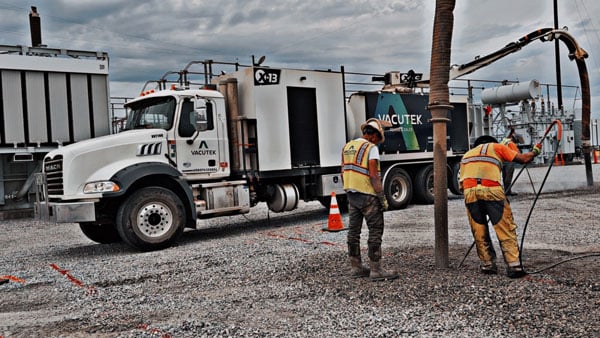
 Utility potholing services help construction teams confirm the location and depth of buried utilities before excavation, drilling, or infrastructure work begins. At Vacutek, we use hydro excavation to expose underground infrastructure with precision, helping contractors, municipalities, and utility providers make better-informed decisions before moving forward with a project.
Potholing, also called daylighting or test-hole excavation, involves creating a small, controlled opening in the ground to physically expose an underground utility. This allows project teams to verify the actual position of buried infrastructure rather than relying entirely on drawings, surface markings, or assumed locations.
Underground networks can include water pipes, sewer lines, gas lines, electrical conduits, and telecommunications cables. Knowing where these assets are located helps engineers and contractors plan excavation routes, coordinate installations, and reduce the risk of accidental utility damage.
Potholing is particularly useful when proposed construction intersects an existing utility corridor or when several underground systems occupy the same area. A verified utility location can help a project team determine where to dig, where to adjust its plans, and what additional coordination may be necessary.
Hydro excavation uses pressurized water to loosen soil and a powerful vacuum system to remove the resulting soil-and-water mixture. This method allows operators to excavate selectively around buried infrastructure instead of relying solely on conventional mechanical digging.
At Vacutek, our hydrovac services support utility exposure, daylighting, test holes, and other precision excavation applications. The excavation can be directed toward a specific area where a contractor needs to confirm the location of an existing line or understand underground conditions.
The size and depth of an excavation depend on the project requirements, soil conditions, utility configuration, and site access. Before work begins, the project team should communicate what needs to be exposed, the available utility information, and any restrictions affecting equipment placement or excavation.
Potholing can be useful at several stages of a construction or infrastructure project. It is especially valuable when knowing the exact position of a buried asset will affect the next construction decision.
Common applications include:
Our soft dig excavation services are relevant to projects that require controlled soil removal around existing underground infrastructure. Selecting the right excavation approach depends on the site, the utility involved, and the work that must follow.
A buried utility can be difficult to assess from the surface alone. If its actual position differs from the expected location, construction crews may need to revise their plans after work has already begun.
Physical exposure provides an opportunity to verify a utility’s position and depth at a particular point. That information can help teams coordinate their work, identify potential conflicts, and make decisions before committing to a larger excavation.
Hydro excavation can also limit unnecessary disturbance around the exposed asset compared with less selective digging methods. However, no excavation method eliminates every hazard. Safe work still requires appropriate utility locating, site planning, operator training, and procedures suited to the specific project.
Potholing should be treated as one part of a broader utility safety process, not a substitute for locating services, required approvals, or the project’s safety plan.
Good preparation helps the excavation crew understand the assignment and plan the work. Before requesting service, gather as much of the following information as possible:
These details help establish the scope of work and identify questions that should be resolved before mobilization. If the utility location is uncertain, explain what is known and what still needs to be verified rather than assuming that existing records are exact.
Vacutek serves utility, construction, transportation, industrial, and municipal projects across the Southeast. You can review our service locations to learn more about our coverage in Georgia, South Carolina, and Florida. Contact our team to discuss projects outside the listed areas.
When evaluating a contractor, ask about its excavation method, operator experience, equipment, safety procedures, scheduling, and ability to accommodate site-specific requirements. You should also clarify how exposed utilities will be protected and how findings will be communicated to the project team.
The right provider should understand that potholing supports a larger construction objective. Accurate exposure is useful only when the resulting information can be incorporated into decisions about excavation, installation, repair, or other planned work.
At Vacutek, we bring our hydro excavation capabilities and focus on safety, quality, and responsive service to utility and infrastructure projects. Our team works with customers to understand their requirements and determine an appropriate approach for the site.
Potholing and daylighting are commonly used to describe the controlled excavation of soil to expose an underground utility. Both methods help project teams physically verify buried infrastructure before proceeding with nearby work.
Hydro excavation uses pressurized water and vacuum removal to loosen and extract soil around buried infrastructure. It can provide controlled exposure, although the appropriate method and precautions depend on site conditions and the utility involved.
A contractor should consider a test hole when confirming the position or depth of an existing utility could affect construction planning. Scheduling before nearby excavation or drilling can help identify conflicts early enough for the team to evaluate its options.
Useful information includes the project location, number and approximate locations of test holes, available utility records, site access conditions, and requested schedule. Providing these details helps Vacutek assess the work and discuss the project’s requirements.
Vacutek serves customers across Georgia, South Carolina, and Florida, including markets around Atlanta, Greenville, Charleston, Jacksonville, Orlando, Tampa, and Sarasota. Contact our team to discuss availability for your specific project location.
If your project requires utility potholing services, we can help you evaluate your hydro excavation needs and coordinate the next steps. Contact Vacutek for a quote or call (404) 737-8822 to discuss your project.